By Moses Omogbeme. Australia’s 7.7 million km2 landmass supports a wide range of agricultural and forestry industries, with about 54% of the land used predominantly for livestock grazing. Most of the landscapes used for commercial grazing across Australia are known as ‘Rangelands’. Livestock coexist with wildlife populations within these rangelands. Consequently, interactions between managed livestock and their predators (i.e., dingoes) are almost inevitable.
Dingoes are serious threats in pastoral landscapes, making livestock production less viable, by causing injuries and increased stress levels in livestock as well as direct predation which can include surplus killing of livestock. Annual losses to the sheep industry and rangeland goat industry of Western Australia (WA) are estimated at AUD$14 million and AUD$11 million respectively. In addition to economic losses, dingo attacks on rangeland livestock cause social distress to pastoralists, making effective control strategies a top priority for pastoralists.
Enormous effort and capital in excess of AUD$230 million per annum is expended on exclusion fences and implementing control measures to manage dingo populations for sustainable livestock enterprise across Australian rangelands. In 2018, the WA state government allocated AUD $4 million in funding, matching over AUD $4 million in-kind contributions, for the construction and fortification of four dingo exclusion fences across the Southern Rangelands of the state (Carnarvon, Kalgoorlie, two in the Murchison Region) to mitigate the economic losses due to the impact of dingoes on livestock.
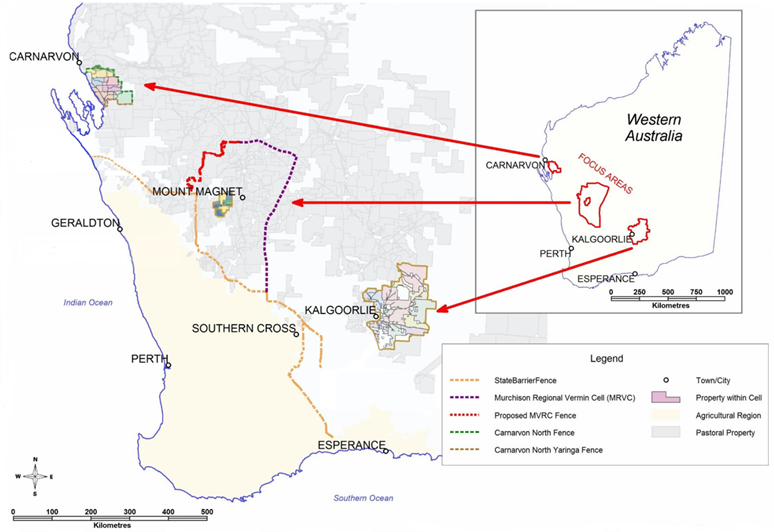
Assessing the effectiveness of these measures is crucial for justifying the investment. Therefore, I monitored dingo populations across six study sites nested in the two fenced cells in the Murchison Region: the Murchison Regional Vermin Cell (MRVC) and the smaller fenced area in the middle of the MRVC (the Murchison Hub Cell).
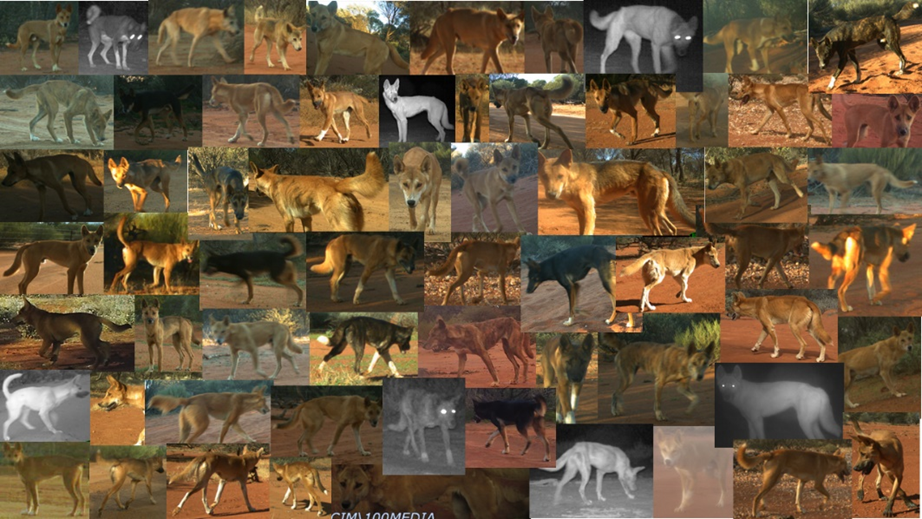
I investigated the effect of landscape-scale dingo exclusion on dingo activity and population density in this landscape, using 24 months of camera trapping surveys along vehicular dirt tracks to address the following research questions: (1) Is dingo activity correlated with resource availability (prey species and access to drinking water) and exclusion fencing? (2) Do dingo activity and population density vary between study sites and over time? (3) Is dingo management in the Southern Rangelands of WA effective for maintenance of small livestock? and (4) Are dingo activity and population density estimates correlated?
Newly published1, my research found significant variation in dingo activity and population density between sites and across time. Exclusion fencing and prey occurrence significantly influenced dingo activity. The annual mean dingo density estimate across study sites was below 2 dingoes per 100 km2 (i.e., 0.02 dingoes per km2; the maximum value believed to be compatible with small livestock) at only one study site in the first year, but it was higher across all sites during the second year of monitoring. Dingo activity correlated with dingo population density at only two sites, suggesting differences in dingo behaviour and detection across the six study sites.
This work provides experimental evidence that control efforts can influence dingo activities along vehicular dirt tracks and not yield a corresponding effect in dingo population size. As such, activity metrics may not be reliable for assessing variations in the dingo population size, as dingoes can be present but less active, presumably as a response to persecution.
- Omogbeme, M. I., Kennedy, M. S., Kreplins, T. L., Kobryn, H. T. & Fleming, P. A. (2025). Activity may not reflect the numbers: an assessment of capture rate and population density of dingoes (Canis familiaris) within landscape-scale cell-fencing. Ecology and Evolution, 15:e71328.
You can read the full paper here ↩︎
 westernWEB